
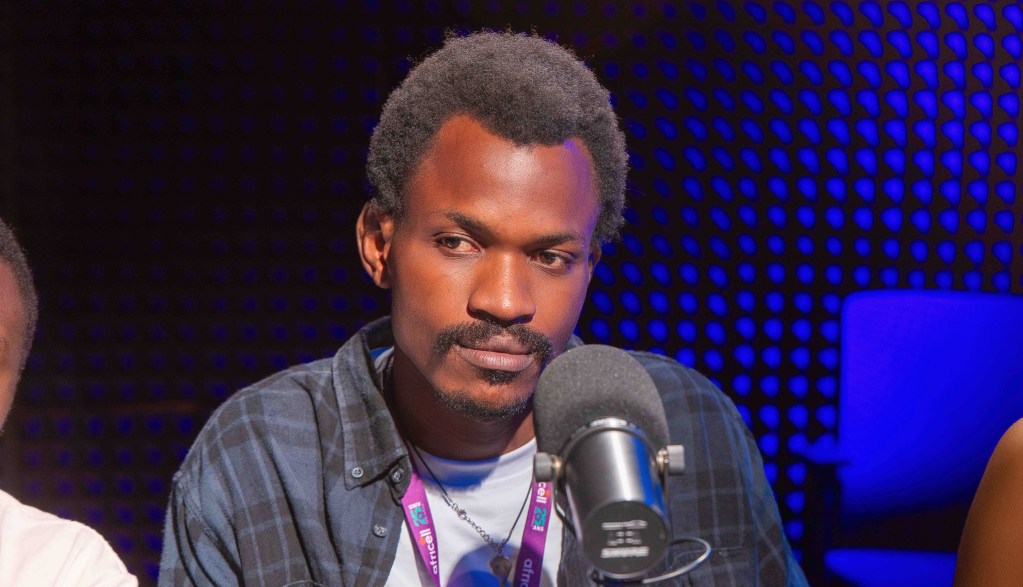
Gloire Nkembo
“I want to persevere, to work without expecting anything in return, and to create works with maturity, with the goal of taking a place in the history of art.”
How has growing up and working in Kinshasa shaped your artistic identity?
Growing up and working in Kinshasa has had at least some impact on my work in terms of my artistic approach, but as far as my artistic identity is concerned, I don’t think it has shaped it that much.
What materials, techniques, or visual languages are at the heart of your practice?
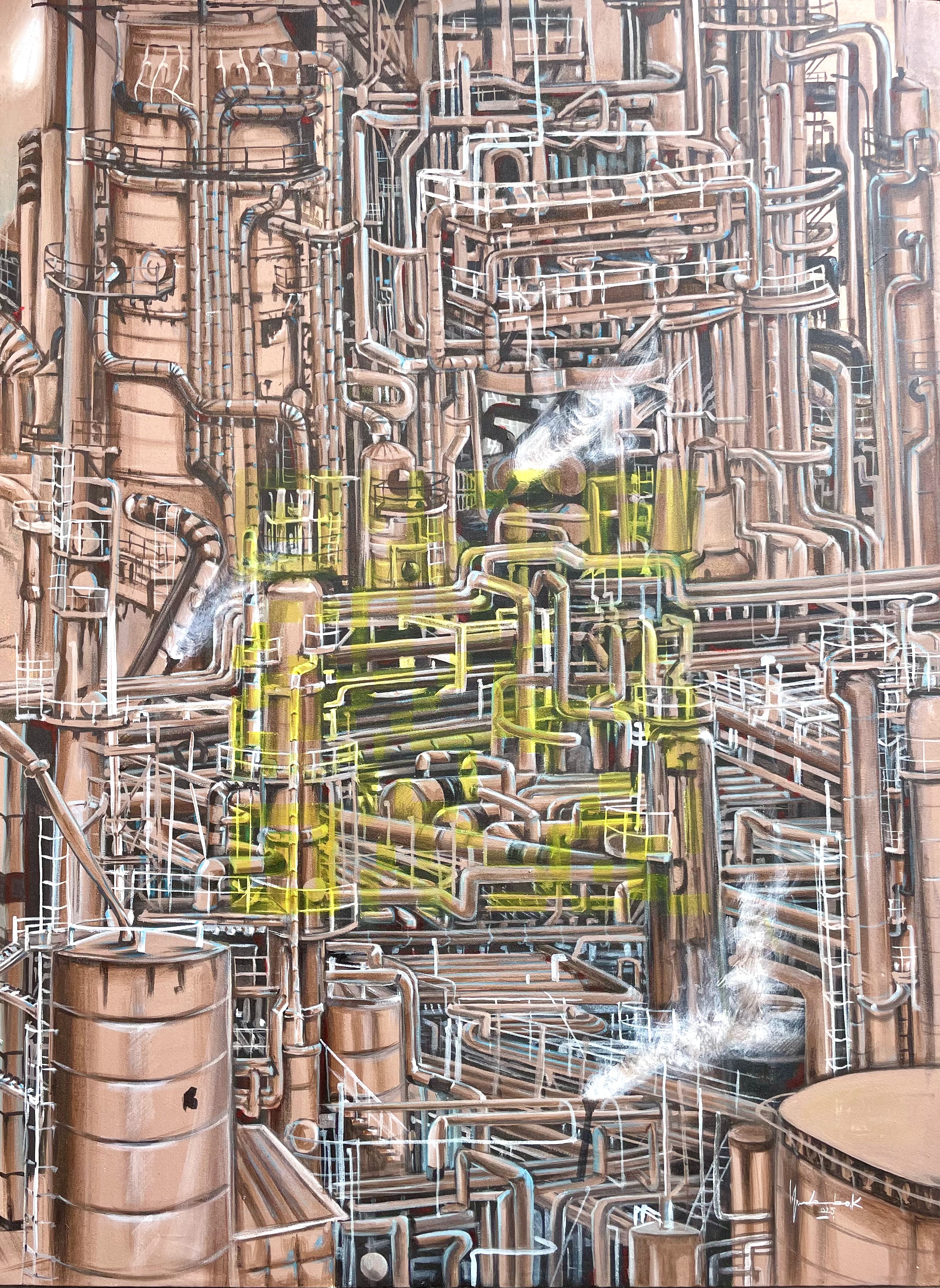
In terms of materials, I paint on canvas, usually acrylic or oil paint. My compositions often feature factories, industrial landscapes, and QR codes layered transparently. These are generally ways of speaking about identification, the preservation of nature, and I place the human being at the centre of everything, as a priority.
Describe your process: how does a new work begin, and how do you know when it is finished?
My process for a work of art has always been somewhat complex, with a logic of building forward, then erasing part of it for something else. I know a work is finished when there is nothing left to remove. That is when I say the work is done, though even then, there are always small adjustments.
What themes or questions keep returning in your work, consciously or not?
Life and its realities, stability, the impact of technology.
Which artists, Congolese or international, have had the greatest influence on you, and why?
The artist Yan Pei-Ming, a French artist of Chinese origin. His journey, his work, and his achievements with major international exhibitions have impressed me enormously.



What does being selected for Elembo Ya Sika mean to you, personally and professionally?
Personally, the Elembo Ya Sika prize 2026 is one of my greatest sources of motivation to throw myself back into the artistic scene in Kinshasa with even more energy. The prize has a moral influence: it helps me not to be swept away by the realities of life in Kinshasa.
How do you plan to use the Winsor & Newton materials? Do you already have a project in mind?
No specific projects in mind for the materials just yet; they will stay in my workspace for my own creations. These materials will help me to be more professional in the way I present my work on the artistic scene.
What have you already learned from the mentorship with Eddy Kamuanga Ilunga?
The mentorship with Eddy Kamuanga has opened my mind in three ways: first, to think more creatively and make better decisions about my artistic career; second, to do thorough research on my projects because art is not just about making things, but about making your creations speak, which will also position me on the great artistic stages of the world; and third, to persevere, to work without expecting anything in return, and to create works with maturity, with the goal of taking a place in the history of art.
In five years, where would you like your work to be seen?
In the United States, Belgium, and France
Français
En quoi le fait de grandir et de travailler à Kinshasa a-t-il façonné ton identité artistique ?
Le fait de grandir à Kinshasa et de travailler à Kinshasa a eu au moins un impact sur mon travail sur le plan de la démarche artistique, mais par rapport à mon identité artistique, je crois pas grand chose.
Quels matériaux, techniques ou langages visuels sont au cœur de ta pratique ?
Par rapport aux matériaux j’utilise la peinture sur toile, souvent la peinture acrylique ou à l’huile, mes compositions sont souvent des usines des industries et les codes QR et barrés en transparence… Souvent c’est pour parler de l’identification, la conservation de la nature et je mets l’humain au centre de tout comme une priorité.
Décris ton processus: comment une nouvelle œuvre commence-t-elle, et comment sais-tu qu’elle est terminée ?
Mon processus pour une œuvre d’art a été toujours un peu très complexe avec une logique d’évoluer en suite effacer une partie pour une autre partie ! Je termine une œuvre lorsqu’il n’y a plus rien à enlever, là je dis que l’œuvre est finie, mais malgré ça, il y a toujours de petites modifications.
Quels thèmes ou questions reviennent sans cesse dans ton travail, consciemment ou non ?
La vie et ses réalités, la stabilité, l’impact de la technologie
Quels artistes, congolais ou internationaux, ont eu la plus grande influence sur toi, et pourquoi ?
L’artiste Yan Pei Ming est un artiste français d’origine chinoise. Son parcours, son travail et ses exploits avec de grandes expositions m’ont beaucoup impressionné ! , et
Que représente pour toi, personnellement et professionnellement, le fait d’avoir été sélectionné pour Elembo Ya Sika ?
Personnellement, le prix Elembo ya sika 2026 est l’une des grandes sources de motivation pour moi! de se remettre encore d’avantage dans la scène artistique à Kinshasa, ce prix à une influence sur Plan moral de se laisser pas emporter par la réalité de Kinshasa.
Comment envisages-tu d’utiliser les matériaux Winsor & Newton; as-tu déjà un projet en tête ?
Les matériaux de Winsor et Newton; pas trop de projets sur ça ! Ça restera dans l’espace de travail pour mes propres réalisations ; ces matériaux m’aideraient à être plus professionnel par la manière de représenter mon travail sur la scène artistique.
Qu’as-tu déjà appris du mentorat avec Eddy Kamuanga Ilunga ?
Le mentorat d’Eddy kamwanga ça m’a ouvert de (1) un esprit créatif, prendre de bonnes décisions sur ma carrière d’artiste , (2) faire de très bonnes recherches sur mes projets parce que l’art n’est pas que l’effet de faire quoi que ce soit, mais fait parler de tes créations me positionnera aussi dans grandes scènes artistique au monde, (3) persévérer, bosser sans rien attendre en retour… Et créer des œuvres dans la maturité et l’objectif de prendre une place dans l’histoire de l’art .
Dans cinq ans, où souhaites-tu que ton travail soit vu ?
Aux États-Unis, Belgique et la France